

On this entry I’ll try to explain the whole subject of the use cases, this will help you to:
- Enumerate and organize functional requirements
- Show model goals for the system you want to create
- Possible difficult scenarios, and flow of events
- Represent it on multi-level way
This tool help to represent and explain better system planning requirements, validating design, testing software for your software development.
Lucky for you I will explain to you this process with one of my projects, Reta60 startup, what my project is trying to accomplish is to join tennis players by a web page, what the players only need to do is sign in, join a public or private club and play schedule with people of your level. Is very often that people don’t want to meet with strangers just for play tennis, they could say that is a risk, but that is what we are trying to use, so the brand make reliable for users and be a successful app.
So good luck and keep up for the next following steps:
First
For the first step you need to identify the actors related with the use of your software, they need to be defined, in my projet case the roles that exist are:
- Player
- Club admin
- Admin (the god one , all above us)
Those previous roles had to be directly connected with you program or software
Second
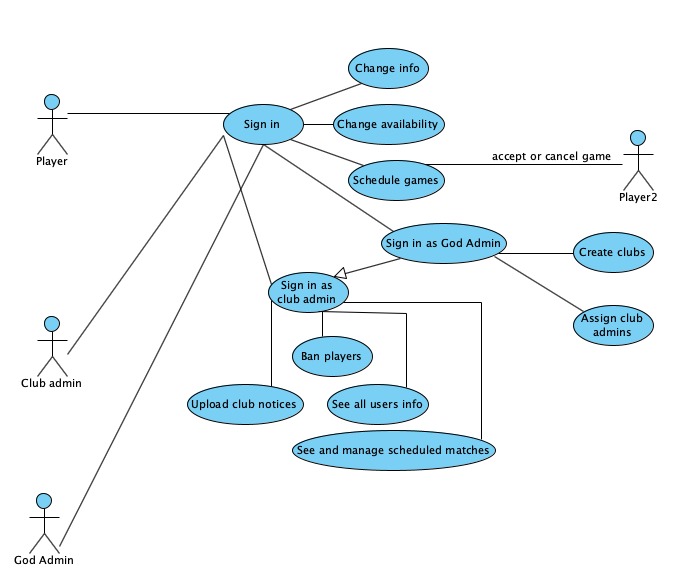
For each role, or actor, you must enumerate their possible actions, and cases and specify what actions will be on those cases
- Player
- Sign in
- Change your information, customizable
- Change availability
- Schedule games with other players
- Accept the schedule games or cancel it
- Club admin
- See all users info signed on the club
- Ban players
- See and manage the schedule matches
- Upload club notices
- Admin (the god one , all above us)
- Create clubs
- Assign club admins
- See all users info
- See and manage all schedule matches
Third
See how they could relate between them and make your diagram for use cases:
 FABIAN'S GEEK STUFF
Leave a comment